Showing posts with label heating and air conditioning. Show all posts
Showing posts with label heating and air conditioning. Show all posts
Friday, March 8, 2013
Ventilation and Air Leakage
Denver heating and air companies define air leakage is the passage of air in and out of various cracks or openings in buildings. It is also sometimes referred to as infiltration. Air leaking into a building may be caused by wind pressure or by differences in temperature inside and outside of the building. In the former case the wind builds up a pressure on one or two sides of a building, causing air to leak into the building. The action of the wind on the opposite side or sides produces a vacuum that draws air out of the building.
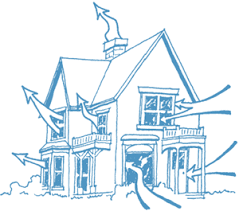 When the wind hits the front side of the building, its momentum builds up a pressure higher than inside the building, which causes the air to leak through any cracks present. AS the wind traverses the length of the building the air currents as the continue past the other side converge and produce a vacuum along this side by induction. Because the pressure on the outside of that side is lower than the inside of the building, air leaks out. Air leakage due to temperature difference or thermal effect is usually refereed to as stack or chimney effect. Air leakage due to cold air outside and warm air inside takes place when the building contains cracks or openings at different levels. This results in the cold and heavy air entering at low level and pushing the warm and light air out at high levels, the same as draft taking place in a chimney. This should be considered when designing for optimal HVAC and furnace efficiency.

Monday, February 4, 2013
Heating and Air Conditioning Systems

A gas forced air system is probably the most common central heating system in the US today. Basically a furnace heats the air which is then blown through your home by a system of fans. When you want to cool the air i.e. in summer, the same system takes the air in your home and passes it via a refrigeration device. That is the most basic explanation but there really isn't an awful lot more to these systems. Do they work? Yes but they are not very efficient, are prone to being drafty and can result in needlessly high energy bills. You could have a standalone electric system which is popular as it is cheap to install. But it is expensive to run and you cannot add air conditioning to the same system so that is an additional cost should you need cool air in the summer.
Wednesday, January 16, 2013
Inspecting Your Heating and Air Conditioning Equipment
This article was found one http://allhvac.blogrog.com and was written By M Siddique
When are examining the issues of home inspection, we can’t think of anything more compelling than the fire hazards. However, the area that brings the most dread is that of the home inspection and the HVAC. This is an abbreviation for: Heating Ventilation and Air-Conditioning. The acronym may be strange to you if you are new to home inspections. You can trust us, the home inspector knows these systems are capital intensive (read: very expensive).
 Of course each situation is a bit different, and there are things you can do to help an older system get along a little bit longer. Tcat has spent many a decade in generally milder climates than Gudrun. Given that, he is a big fan of the attic fan. (No pun intended).
[read entire article]
When are examining the issues of home inspection, we can’t think of anything more compelling than the fire hazards. However, the area that brings the most dread is that of the home inspection and the HVAC. This is an abbreviation for: Heating Ventilation and Air-Conditioning. The acronym may be strange to you if you are new to home inspections. You can trust us, the home inspector knows these systems are capital intensive (read: very expensive).
[read entire article]
Subscribe to:
Posts (Atom)